







By Sigma Politics Desk
India is approaching a political turning point that could redefine its democracy for decades—delimitation after 2026. Presented as a constitutional necessity, it is being pushed as a technical correction. But beneath the surface, it is a fundamental redistribution of political power.
The debate is not really about procedure. It is about who will control India’s political future.
The New Push: What’s Happening Now
The urgency around delimitation has intensified in 2026:
- The government is preparing a fresh delimitation exercise after the long freeze ends
- Discussions include expanding the Lok Sabha significantly
- The implementation of women’s reservation is still linked to census and delimitation timelines
- At the same time, signals suggest the government may try to decouple reservation from delimitation, exposing policy inconsistency
Despite this, there is no broad political consensus and no detailed public blueprint.
That silence is not procedural—it is political.
The Core Reality: Numbers Will Decide Power
Delimitation is based on population. That is the rule.
But rules have consequences.
If implemented strictly on population data:
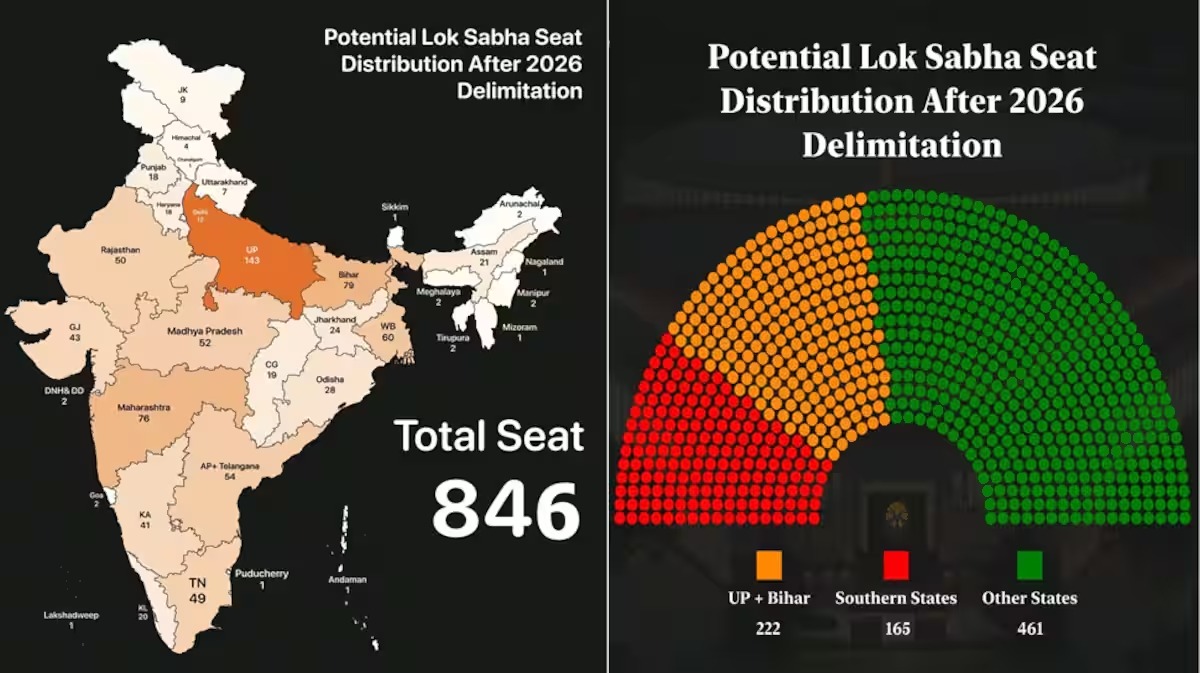
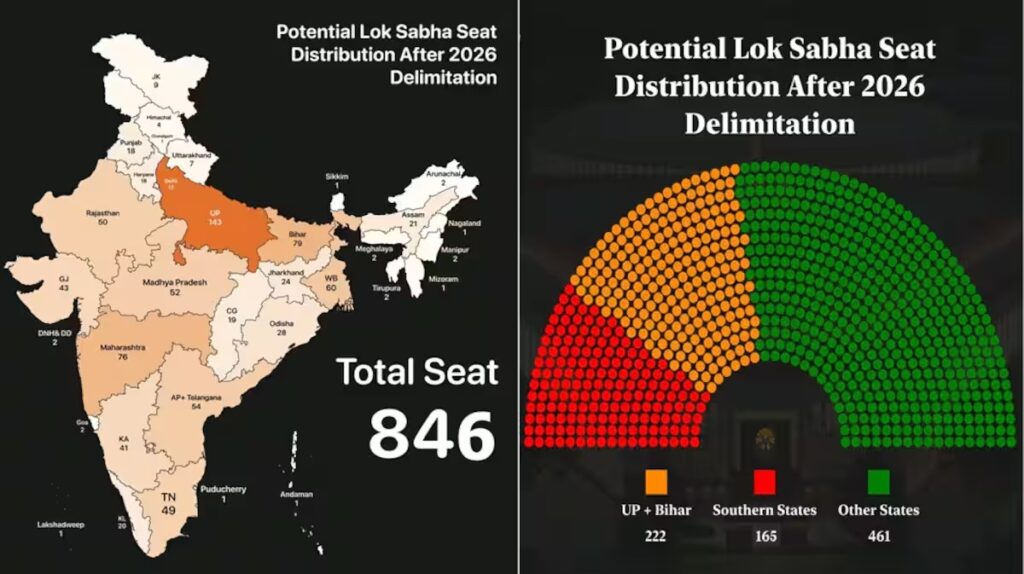
- Northern states like Uttar Pradesh and Bihar will gain more parliamentary seats
- Southern states like Tamil Nadu and Kerala will lose relative influence
This is not politics. This is arithmetic.
And arithmetic, in this case, is not neutral.
The Injustice No One Wants to Admit
For decades, India asked its states to:
- Control population
- Invest in human development
- Strengthen governance
Some states did exactly that.
Now, those very states face a paradox:
The better you governed, the less political power you may have.
Meanwhile, states with higher population growth stand to gain greater representation.
This creates a dangerous incentive structure:
- Governance becomes irrelevant
- Demography becomes destiny
The Federal Faultline
India’s strength lies in its federal balance.
Delimitation, if done purely on population, risks breaking that balance:
- It can create permanent regional dominance
- It can reduce some states to political spectators
- It can ignite a North vs South divide that goes beyond elections
This is not just about seats. It is about voice, influence, and dignity within the Union.
The Census Question: Data or Delay?
Another layer of concern is timing.
- India’s next Census—crucial for delimitation—is still pending clarity
- Yet, political momentum for delimitation is accelerating
Without reliable, updated data, delimitation risks becoming:
A political decision disguised as a demographic exercise
A flawed base will produce a flawed democracy.
Opposition vs Government: Two Visions
The divide is clear:
- The Opposition demands consensus, proper census, and equitable distribution
- The government insists on population-based delimitation as the only fair model
But fairness is not always mathematical.
Even voices like Sonia Gandhi have stressed that delimitation must be politically equitable, not just numerically correct.
That distinction is not semantic—it is existential.
What Is Really at Stake
This delimitation could:
- Redefine Lok Sabha power structure for decades
- Change the nature of coalition politics permanently
- Tilt the balance of Centre-State relations irreversibly
In simple terms:
This is not an electoral reform.
This is a restructuring of the Indian Republic.
Sigma Politics View: The Line That Matters
Delimitation is necessary. But the way it is executed will decide whether it strengthens democracy—or weakens it.
Because the truth is simple and uncomfortable:
“Delimitation without consensus is not reform—it is the redistribution of domination.”
Final Word
India cannot afford a democracy where:
- Some states dominate
- Others merely exist within the system
Representation must be fair—not just in numbers, but in spirit.
Because once power is structurally skewed,
it is not easily corrected.
And when democracy loses balance,
it does not collapse overnight—
it tilts slowly, permanently, and silently.